10th October 2023
Sydney, Nova Scotia, was our port of call today. Once a former city and urban community on the east coast of Cape Breton Island, it was founded in 1785 by the British. Sydney served as the colonial capital of Cape Breton Island until 1820, when the colony merged with Nova Scotia and the capital was relocated to Halifax. By the early 20th century, Sydney had become home to one of the world’s largest steel plants, fuelled by the many coal mines in the region. The harbour also played a key role during the Second World War, acting as a staging point for supply convoys bound for Europe.
Unfortunately, the view from the cabin TV’s bow camera was far from inspiring, with steady rain and a thick blanket of cloud showing no signs of lifting. We had originally booked an excursion to visit the local Eskasoni tribe, but this was cancelled several days ago due to a lack of interest; only 14 places had been taken.
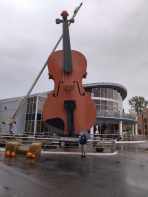
Though passengers were cleared to disembark by 8 a.m., we delayed our departure until 8:45 a.m., as the rain showed no sign of letting up. By then, the tour buses had already left the quayside, and we joined just a few other brave (or perhaps foolhardy) souls willing to venture out and get wet.
Fortunately, the cruise terminal is very close to many of the city’s key tourist attractions, and it’s also home to what is likely the most striking sight one could encounter upon leaving a ship. At one end of the terminal stands the largest violin imaginable. Even in the increasing rain, it was worth getting the camera out and asking Sue to pose for a shot.
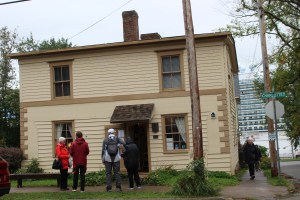
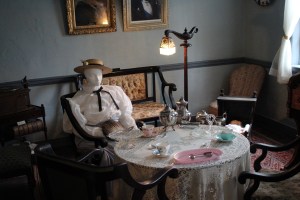
Leaving the port, we quickly found Charlotte Street, home to several museums and the majority of the town’s shops. By the time we reached our first point of interest, the rain had eased to a gentle drizzle. The Cossitt House Museum, built in 1787, is one of the oldest surviving houses in Sydney, and quite possibly one of the oldest buildings on Cape Breton Island. It is named after its original owner, Reverend Ranna Cossit.
The well-presented exhibits and artefacts offer a fascinating insight into life in Nova Scotia some 230 years ago. But the story behind the house is even more compelling. Reverend Ranna Cossit and his wife, Thankful, were Loyalists during the American Revolution. They chose to leave the thirteen colonies and resettle in a region that remained loyal to the British Crown. Their story adds a valuable dimension to the broader narrative of that era, reminding us that not everyone sought independence from British rule. A visit here is well worth the time.


By the time we moved on to the Jost Heritage House, just 20 metres or so across the road, the rain had stopped. Once the home of the prominent merchant Samuel Sparrow in 1786, the rooms demonstrate the evolution of a wooden dwelling over three centuries. The museum features displays on local marine life, Cape Breton history, and a reconstructed apothecary.
The entrance fee was $4 each, but as we only had $2.65 in Canadian dollars, they kindly let us in and, along with another couple, gave us a very comprehensive guided tour of the property. The building spans three levels, each room containing artefacts relevant to its history. At first glance, it appears to be a very ordinary old Canadian home, yet the guides bring the building to life with many engaging tales, immersing visitors in the colonial atmosphere of the town. Well worth a visit.
As we left, the rain began again, urging us on to our next stop, St. George’s Anglican Church, just a block away from the home of its priest, Reverend Ranna Cossit. The church, like many we have seen over the years, is quite unremarkable, but it offered some welcome respite from the weather. We completed our walk along Charlotte Street in the rain, quickly browsing the retail outlets as we made our way back to the ship.
We took lunch in the buffet restaurant, watching the rain fall steadily on the good citizens of Sydney from our window table high up on Deck 17. After the meal, we spent half an hour in our cabin catching up with the news on BBC World News before donning raincoats and venturing out once more.

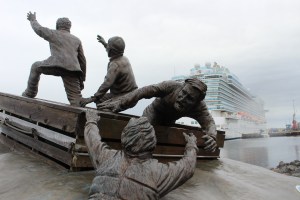
Our walk along the boardwalk to Wentworth Park was a pleasant stroll in a light drizzle. There were a few other cruisers also following the path, but not many. We passed numerous information boards and several statues; on a better day, we would have spent more time absorbing their content. However, several diversions caused by building works added discomfort and annoyance, so we soon hurried on. The park was created in 1786, just a year after Sydney’s founding, making it the oldest park in Sydney. It centres around Wentworth Creek, which forms a series of small interconnected ponds. We circumnavigated the largest pond before returning to the Sky Princess.
The evening show featured Jay McGee, vocalist and former frontman of the 1960s chart-topping comedy show band The Rockin’ Berries. A professional performance, and very, very funny.


Leave a Reply